
Fostering Resilience and Adaptability in Children
There is a moment in every workshop that looks, from the outside, like failure.
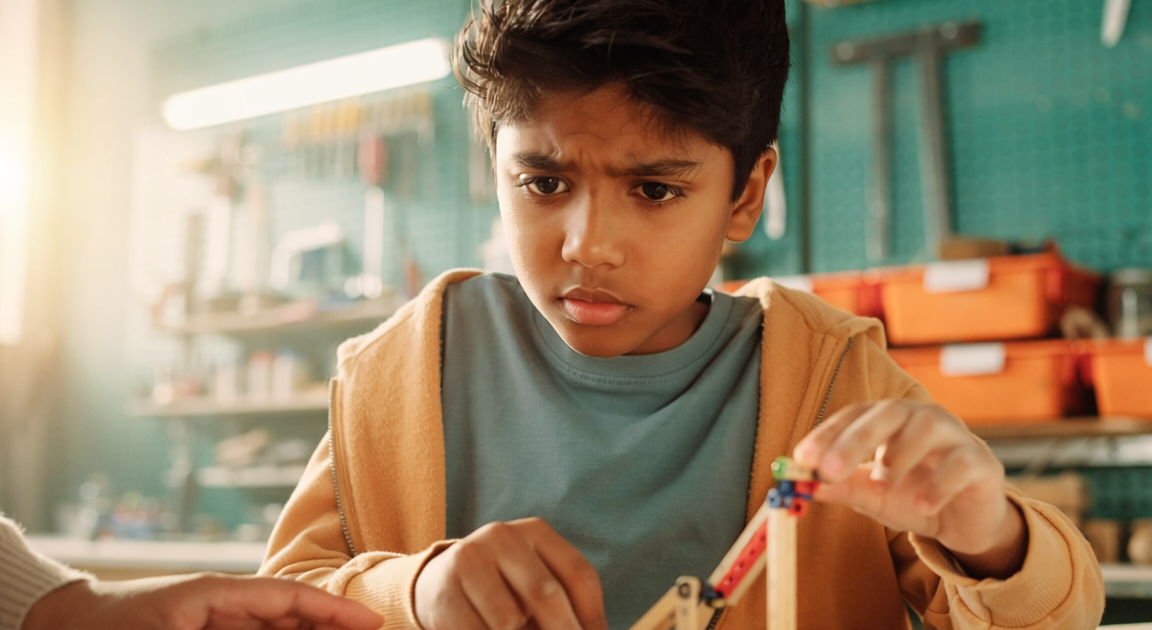
A child has spent twenty minutes building something. A gear-powered device, a miniature aqueduct, a carefully assembled structure. They test it. It does not work. And for a brief second, they go quiet.
What happens in that silence matters more than almost anything else in the entire session.
Because it is in that moment — not in the triumph, not in the praise, but in the quiet after something breaks — that resilience either takes root or retreats.
What Resilience Really Means
Resilience is often described as the ability to bounce back from difficulty. But that definition undersells it. True resilience is not about bouncing back to where you were. It is about adapting, recalibrating, and moving forward in a way that makes you stronger than you were before.
For children, resilience is one of the most important qualities they can develop — not because life will be hard (though it will), but because every meaningful thing they will ever attempt will involve setbacks. Learning to ride a bike. Making a friend. Solving a difficult problem. Starting something new. The child who has learned to meet difficulty with curiosity rather than defeat will always go further than the child who has only ever been protected from it.
Why Comfortable Learning Does Not Build Resilience
A child who is always guided to the right answer, always corrected before they make a mistake, always reassured before they have the chance to feel uncertain — that child is being protected from something they desperately need.
Productive struggle — the experience of being genuinely challenged without knowing immediately how to proceed — is the primary engine of resilience. It is what builds the mental and emotional muscle that allows children to face harder challenges later. Without it, even minor setbacks can feel catastrophic, because a child has no inner evidence that they have ever recovered from difficulty before.
The goal is not to make things harder for the sake of it. The goal is to resist making things artificially easy.
What Failure Looks Like in a Hands-On Session
When a child builds a miniature aqueduct and the water does not flow correctly, several things happen in quick succession. First, surprise. Then frustration — small, but real. Then, if the environment is right, curiosity: why didn’t it work?
That question — why didn’t it work? — is the pivot point. It is the moment where a child decides whether difficulty is a dead end or a data point. In a well-designed hands-on session, children are guided to treat every failure as information. The gear didn’t turn because the teeth aren’t aligned. The water stopped because the slope was too shallow. The structure fell because the base was too narrow.
These are not failures. They are experiments with unexpected results. And every unexpected result is a chance to adapt.
The Test, Fail, Improve Cycle
The most powerful thing a child can internalise is the understanding that improvement is a process, not a moment. Great engineers, scientists, and builders do not get things right the first time. They get things right the last time — after many iterations of testing, failing, and improving.
When children work through this cycle repeatedly — build something, test it, notice what went wrong, adjust, test again — they are not just learning about mechanics or science. They are building an identity. The identity of someone who does not give up when things go wrong. Someone who treats obstacles as puzzles rather than proof that they cannot do it.
That identity, once formed, carries far beyond any workshop table.
Adaptability — The Other Half of the Equation
Resilience and adaptability are two sides of the same coin. Resilience is the ability to recover from difficulty. Adaptability is the ability to change your approach when the situation demands it.
Children who are adaptable do not panic when circumstances change. They look at the new situation, assess what tools and ideas are available to them, and begin reconfiguring their approach. This is a skill that is almost impossible to teach directly — but it develops naturally in children who have spent time solving open-ended problems where no single method is guaranteed to work.
When a child realises mid-experiment that their first plan will not work and shifts to a second approach without being told to — that is adaptability in action. And every time they do it, it becomes more instinctive.
How Parents Can Foster Resilience at Home
The home environment plays an enormous role in how resilient a child becomes. Small daily choices shape big long-term patterns.
- Let them sit with difficulty a little longer. Before stepping in to help, pause and observe. Often, a child just needs a few more minutes and a quiet vote of confidence.
- Normalise struggle in your own life. Share moments when things did not go to plan and what you did next. “I tried this, it didn’t work, so I tried this instead” is a powerful model for children to witness.
- Praise the process, not just the outcome. “I noticed you kept trying even when it got hard” is more powerful than “well done for getting it right.”
- Avoid rescuing immediately. Problem-solve together rather than solving for them. Ask “what do you think you could try?” before offering a solution.
- Create low-stakes environments for failure. Games, cooking together, building projects at home — these are safe places for children to practise recovering from things going wrong without high consequences.
The Child Who Keeps Going
The most capable adults are not the ones who never struggled. They are the ones who struggled — and kept going. Who adjusted, adapted, and found a way forward even when the path was not clear.
That quality is not innate. It is built. It is built in the quiet moment after something breaks, when a child looks at the pieces and decides to try again.
At Active Growth Hub, we design every session to give children exactly that moment — the real challenge, the real setback, and the real discovery that they are capable of more than they thought.