
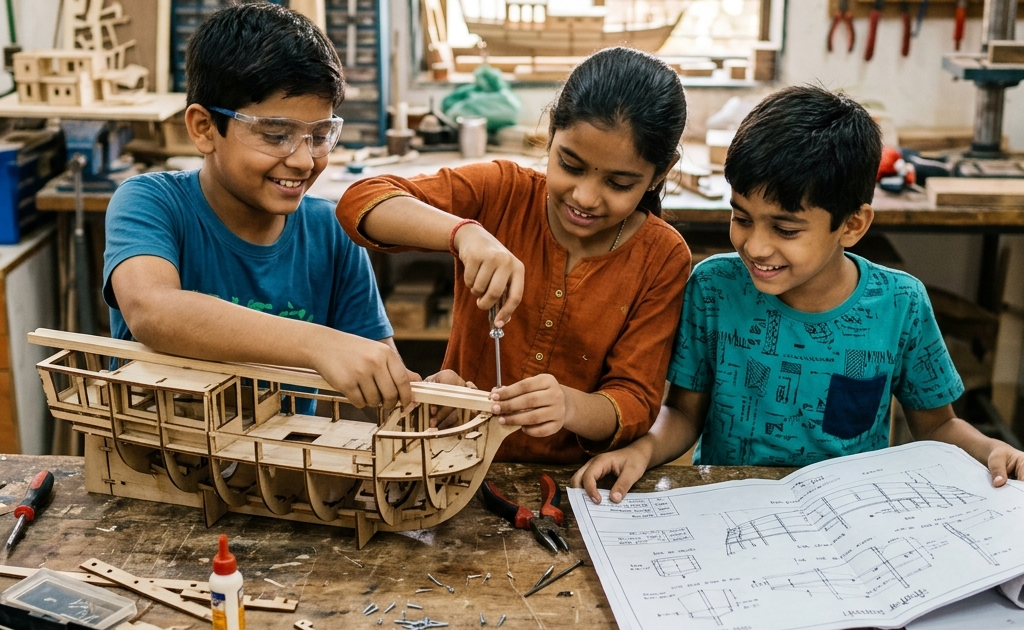
Cultivating Collaborative Skills in Children
If you look at the greatest achievements in history — the building of cities, the launch of space missions, the development of modern medicine — none of them were accomplished by a lone genius working in a room. They were the result of collaboration. People with different talents, different perspectives, and different ideas coming together to build something that none of them could have created alone.
In a world that increasingly relies on complex teamwork, the ability to collaborate is not just a “nice-to-have” social skill. It is one of the most important tools a child can develop for their future.
What Collaboration Actually Means
Collaboration is often mistaken for simply sitting next to someone else while you do your own work. But real collaboration is deeper. It is the ability to listen to another person’s idea, incorporate it into your own, compromise when necessary, and share the credit when the goal is reached.
It is a skill that balances two things that don’t always naturally go together: having the confidence to contribute your own ideas, and having the empathy to support someone else’s.
The Challenge of Teamwork
For children, collaboration can be hard. It requires putting the group’s goal above your own immediate desire. It requires waiting for your turn, listening when someone else has the floor, and sometimes letting go of an idea you liked because a teammate found a better one.
These are not easy tasks. But the only way to learn them is through practice. A child cannot learn to be a good team player by reading about it; they learn by being in a group, hitting a snag, and figuring out how to navigate it with others.
Hands-On Learning as a Collaboration Lab
Hands-on workshops are perfect environments for practising collaboration because they provide a concrete goal that everyone cares about. When a group of children has to build a functioning gear system or complete an engineering challenge, they are naturally incentivised to work together.
In these environments, they have to navigate the inevitable differences that come up:
- How do we decide which part to build first?
- What do we do if we disagree on the design?
- How can we make sure everyone gets to contribute?
When they work through these questions, they aren’t just learning how to build. They are learning how to lead, how to follow, and how to communicate. They learn that the project is stronger when everyone’s voice is heard, and they experience the unique satisfaction of achieving something together that would have been impossible on their own.
How Parents Can Help at Home
You can help your child build collaborative instincts through small, everyday habits.
- Encourage family projects. Whether it is cooking a meal, gardening, or cleaning up, frame it as a team effort where everyone has a role.
- Model respectful disagreement. Show your child how to disagree with someone without being unkind. “I see what you mean, but I was thinking we could try this…” is a great phrase to practice.
- Value the group contribution. When a project is finished, ask questions about how the team worked: “What did you learn from your teammates?” “What was the hardest part about working as a group?”
- Create opportunities for group play. Encourage your child to join workshops, sports teams, or community groups where they can interact with peers who have different strengths and interests.
- Celebrate the win as a group. If a team achieves something, focus the praise on the effort of the team rather than the performance of one individual.
Preparing for the Future
The world our children are entering doesn’t want just one kind of person. It needs the builder, the listener, the negotiator, and the leader. By helping them develop collaborative skills now, we are giving them the confidence to step into any group and contribute meaningfully.
At Active Growth Hub, we build our workshops to be collaborative labs. We know that the best ideas don’t just come from one child — they come from the spark that happens when many children work, think, and solve together.