
Unleashing Entrepreneurial Spirit in Children
When we talk about the “entrepreneurial spirit” in children, we aren’t talking about starting a company at age ten (though some might!). We are talking about something much more fundamental: the ability to look at the world, see a problem, and believe that you have the power to create a solution.
That belief — the “can-do” spirit — is the hallmark of every builder, inventor, and leader. It is the conviction that the world is not finished, and that you are an active participant in shaping it.
Entrepreneurship as a Mindset
An entrepreneurial mindset is built on a few core traits: curiosity, the courage to take risks, resilience in the face of failure, and the ability to imagine things that don’t yet exist. These are not traits that belong only to business owners. They are human traits that serve every aspect of life.
When we nurture this spirit, we aren’t just training future CEOs. We are helping children grow into adults who are not afraid of challenges, who think independently, and who are constantly looking for ways to improve the world around them.
The Power of “Building from Nothing”
The most important lesson in entrepreneurship is that you don’t need permission to start. You just need an idea and the willingness to try.
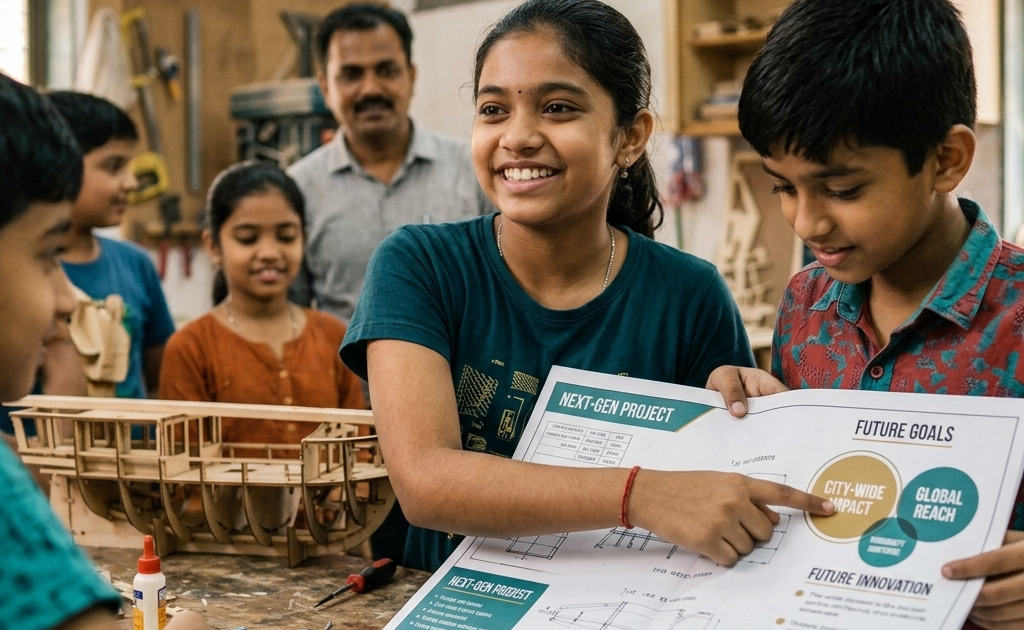
Hands-on workshops are essentially “entrepreneurial labs.” When a child faces a challenge — like figuring out how to make a chariot point in a fixed direction or how to lift water with a screw — they are faced with a blank slate. They have to:
- Define the problem.
- Sketch a plan.
- Build a prototype.
- Test it.
- Fix what doesn’t work.
This is the exact cycle that drives every great idea. By repeating this process, children learn that they are not just consumers of the world around them; they are creators. That shift in perspective is the foundation of the entrepreneurial spirit.
Encouraging the Inventor’s Mindset
You can foster this spirit at home by treating your child as a partner in problem-solving.
- Encourage small inventions. If they have a problem at home — like a messy toy box or a door that won’t stay open — ask them to come up with three ways to fix it.
- Focus on the “why” and the “how.” When you see someone who has built something impressive, talk about it. “Look at this tool; who do you think decided to make it? What problem do you think they were trying to solve?”
- Let them manage a project. Give them a small project (like planning a meal, building a birdhouse, or organising a cupboard) and let them own it from start to finish. Support them, but don’t take over.
- Normalise the “pivot.” Show them that when something doesn’t work, it is not a failure — it is just a signal to try a different approach. That flexibility is the heart of every successful business and invention.
- Value their ideas. When they have a “crazy” idea, listen seriously. Even if the idea isn’t practical, the process of coming up with it is.
The Future Belongs to the Creators
The world our children are entering is changing faster than ever. It will belong to the people who are the most adaptable, the most creative, and the most comfortable with the unknown. By fostering this entrepreneurial spirit now, we are giving our children a permanent advantage. We are teaching them that they have the agency to change their own circumstances and to shape the world.
At Active Growth Hub, we don’t just teach children how to follow instructions. We teach them how to create their own paths. We want every child to leave our workshops not just with a completed project, but with the confidence that when they see a problem, they have the power to create a solution.