
Tips to Live a More Creative Life
We often talk about creativity as if it were a talent reserved for a lucky few — painters, musicians, or writers. But the truth is much simpler: creativity is a way of living.
It is how we solve the everyday problems that life throws at us. It is how we stay engaged with the world, how we keep our curiosity alive, and how we find joy in the process of building, learning, and growing. If you want your child to be creative, the best thing you can do is model a creative life yourself.
Creativity is a Daily Habit
Creativity is not a light switch you turn on when you need a “big idea.” It is a muscle that gets stronger with daily use. It is found in the small decisions you make, the way you structure your time, and the attitude you bring to the inevitable bumps in the road.
When you show your child that you are constantly finding new ways to do things, questioning how systems work, or taking time to build something with your hands, you aren’t just teaching them about creativity. You are showing them that creativity is a normal, healthy part of adult life.
Simple Tips to Cultivate Creativity at Home
You don’t need a massive budget or a dedicated studio to build a creative home. It is all about shifting your focus from “finishing things” to “exploring things.”
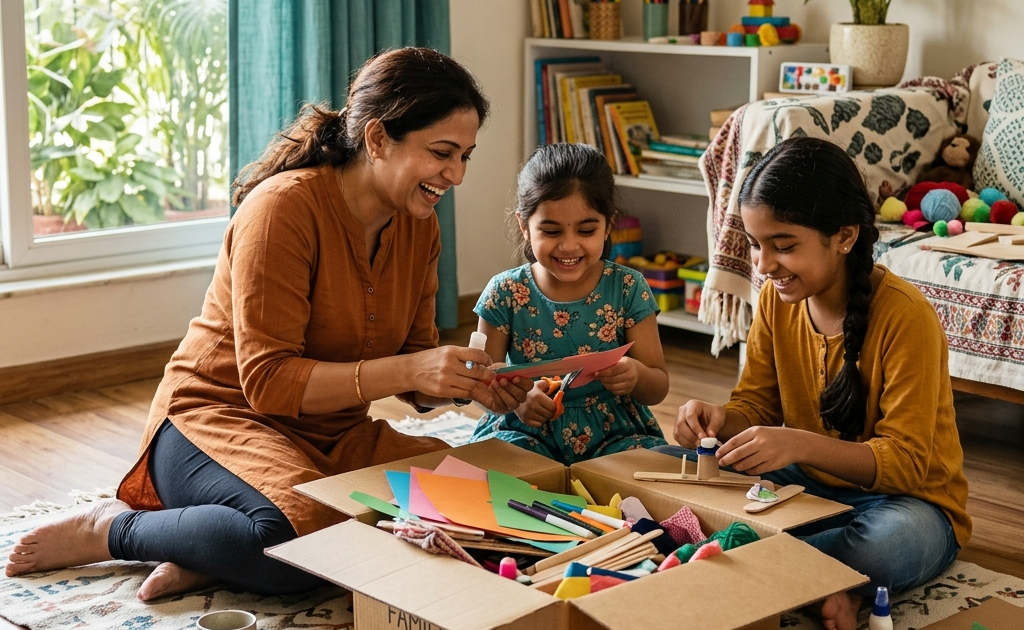
- Create a “Maker Corner.” Set aside a small space (even just a drawer or a box) filled with raw materials: cardboard, tape, string, paper, old boxes, glue, markers. When the materials are visible and accessible, creativity happens without any prompting.
- Value “Messy” Play. Creativity is rarely neat. Give your children (and yourself) the freedom to make a mess while exploring an idea. The cleanup is a small price to pay for the exploration that happened in the process.
- Ask “What if?” instead of “What is it?” When your child shows you a drawing or a build, resist the urge to ask “What is it?” Instead, try “Tell me about how you made this,” or “What do you think would happen if you added [X]?” It keeps the conversation focused on the process of creation.
- Schedule “Unscheduled” Time. In a world of back-to-back lessons and screen time, unstructured time is where creativity is born. Let your children be bored occasionally; boredom is the precursor to an inventive mind.
- Model Your Own Creative Process. Share what you are working on. Are you trying to organise the pantry? Fix a leaky tap? Learn a new recipe? Talk about the challenges you faced and how you solved them. When they see you thinking creatively, they learn that it is a natural human trait.
- Step Away from Screens. Screens provide a high-frequency, passive form of entertainment that leaves little room for original thought. Prioritise time for activities that require active creation — reading, building, playing, gardening, or cooking — and notice how the energy in the house changes.
The Goal: A Creative Culture
A creative life is not about being “artistic.” It is about having a mindset that says, “I can engage with the world, I can understand it, and I can shape it.”
When you foster this culture in your home, you aren’t just raising children who get better grades. You are raising children who are more resilient, more curious, more collaborative, and more confident in their ability to face whatever the future brings.
At Active Growth Hub, we believe that creativity is the most powerful tool for growth. We see it every day in our workshops: the moment a child moves from being a passive observer to being an active creator. It is a transformation that stays with them, and it is the best gift we can help them develop.