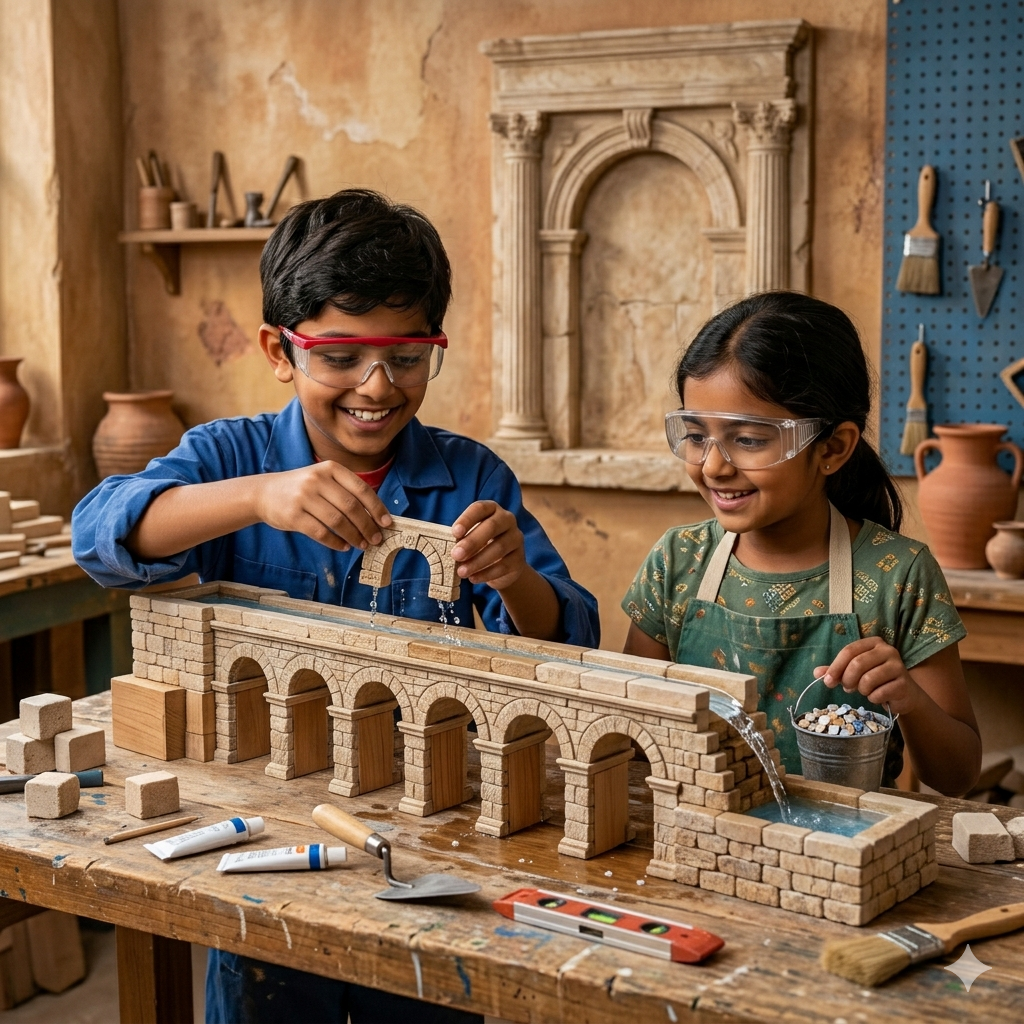
Roman Aqueducts
₹500.00 Original price was: ₹500.00.₹250.00Current price is: ₹250.00.
Engineer your own gravity-defying water bridge — the Roman way!
Roman aqueducts are one of the greatest feats of ancient engineering. Built over 2,000 years ago, they transported fresh water across mountains, valleys, and cities — using nothing but the mathematics of slope and gravity.
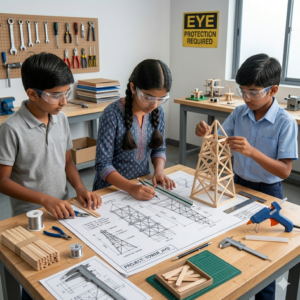
In this session, your child becomes a Roman engineer. They are given a design brief, provided materials, and challenged to build a working miniature aqueduct that carries water from one elevated point to another. Slope, angle, joint strength, and stability all matter — and children discover this through trial, error, and brilliant problem-solving.
Did you know? Some Roman aqueducts were so precisely engineered that they dropped only 1 centimeter in height for every 5 metres of length — an almost perfectly flat gradient!
What your child will do:
-
Study the design principles behind real Roman aqueducts
-
Plan and sketch their own aqueduct design
-
Build a miniature model using provided materials
-
Test water flow and adjust slope and joints
-
Present findings to the group
What your child will learn:
-
The role of gravity in water movement
-
Civil engineering basics: slope, gradient, and load-bearing structures
-
Measurement, estimation, and spatial planning
-
Structural problem-solving under real constraints
-
Roman history and ancient engineering achievements
Product Details
Key Learning Outcomes
-
Understanding of gravity and gradient in water movement
-
Civil engineering concepts: slope, joints, and load
-
Measurement, spatial reasoning, and planning
-
Historical context of Roman infrastructure
-
Creative design thinking and iterative testing
Engineer your own gravity-defying water bridge — the Roman way!
Roman aqueducts are one of the greatest feats of ancient engineering. Built over 2,000 years ago, they transported fresh water across mountains, valleys, and cities — using nothing but the mathematics of slope and gravity.
In this session, your child becomes a Roman engineer. They are given a design brief, provided materials, and challenged to build a working miniature aqueduct that carries water from one elevated point to another. Slope, angle, joint strength, and stability all matter — and children discover this through trial, error, and brilliant problem-solving.
Did you know? Some Roman aqueducts were so precisely engineered that they dropped only 1 centimeter in height for every 5 metres of length — an almost perfectly flat gradient!
What your child will do:
-
Study the design principles behind real Roman aqueducts
-
Plan and sketch their own aqueduct design
-
Build a miniature model using provided materials
-
Test water flow and adjust slope and joints
-
Present findings to the group
What your child will learn:
-
The role of gravity in water movement
-
Civil engineering basics: slope, gradient, and load-bearing structures
-
Measurement, estimation, and spatial planning
-
Structural problem-solving under real constraints
-
Roman history and ancient engineering achievements
Product Details
Key Learning Outcomes
-
Understanding of gravity and gradient in water movement
-
Civil engineering concepts: slope, joints, and load
-
Measurement, spatial reasoning, and planning
-
Historical context of Roman infrastructure
-
Creative design thinking and iterative testing